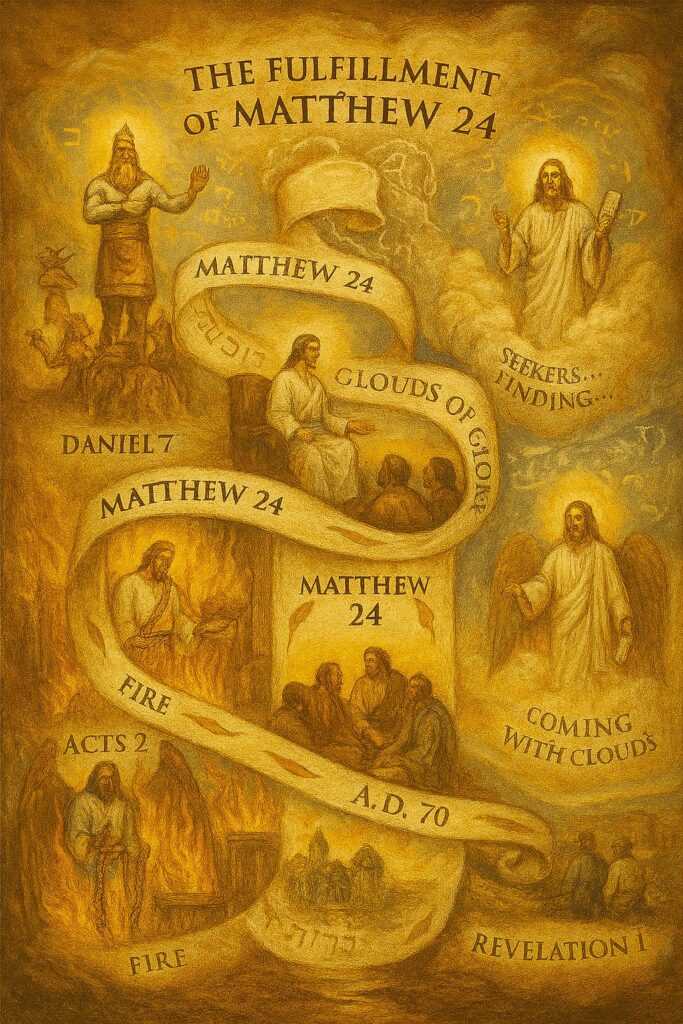

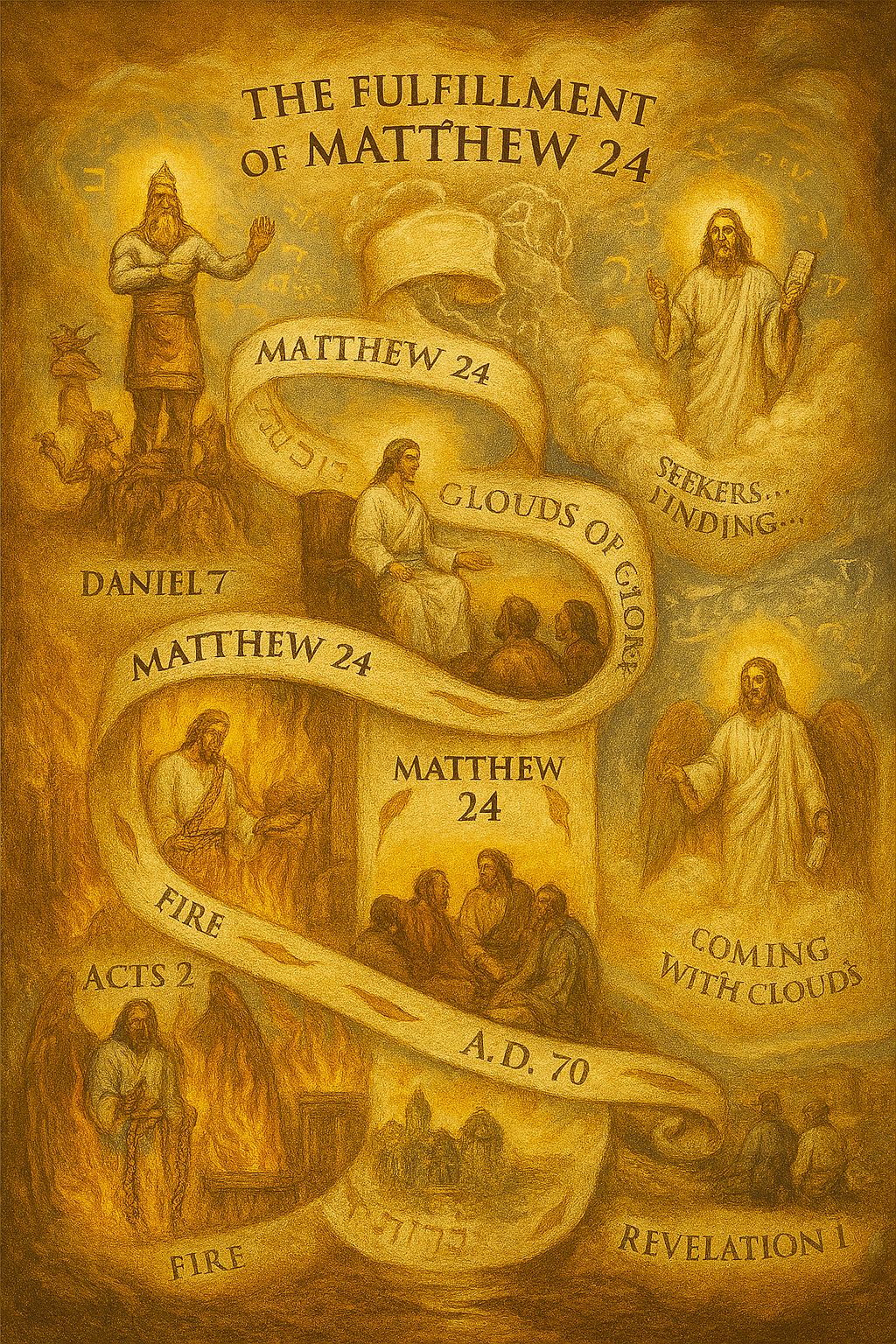
Canonical, prophetic master‑narrative:
Matthew 24 at the spine, with every related passage woven around it into one coherent story from Daniel → Jesus → Acts → Hebrews → AD 70 → ongoing appearing.
I’ll do three things:
1. Give you the full storyline in narrative form.
2. Anchor it with key passages and Greek/Hebrew terms (selective, not an impossible full interlinear).
3. Show you how it forms a prophetic timeline you can plug straight into AO / Refined Church.
—
1. The root: Daniel sees the Son of Man in the clouds of heaven
Long before Jesus, Daniel is given the blueprint.
Daniel 7 (summary):
– Daniel sees thrones set in place, and the Ancient of Days seated.
– He then sees “one like a Son of Man” coming with the clouds of heaven.
– This Son of Man is brought before the Ancient of Days.
– He is given dominion, glory, and a kingdom, so that all peoples, nations, and languages serve Him.
– His dominion is everlasting, and His kingdom shall not be destroyed.
Key Aramaic terms:
– “Son of Man”
– Aramaic:
– כְּבַר אֱנָשׁ (kevar ’enash) – like a son of man, a human‑like figure.
– “Clouds of heaven”
– עִם עֲנָנֵי שְׁמַיָּא
– ‘im ananei shemaya
– עֲנָנֵי (ananei) – clouds
– שְׁמַיָּא (shemaya) – heavens
These are not meteorological clouds. They are glory clouds – the radiant, luminous presence of Yahuah. Daniel 7 is not describing a weather pattern; it is a throne‑room event in the heavenly realm where the Son of Man receives kingdom authority.
Timeline node 1:
The Son of Man will be enthroned in glory, in the clouds of heaven, and given an everlasting kingdom.
—
2. John the Baptist and Jesus: the kingdom is at hand, the axe is at the root
When Jesus comes on the scene, He speaks as if Daniel’s vision is about to unfold in their generation.
John the Baptist:
– “The kingdom of heaven is at hand.”
– “The axe is laid to the root of the trees.”
– “His winnowing fork is in His hand.”
Judgment and kingdom are imminent, not remote.
Jesus:
– “Repent, for the kingdom of heaven is at hand.”
– He proclaims the kingdom and confronts the religious leadership.
– He warns repeatedly of a coming judgment on that generation (e.g., Matthew 23).
Matthew 23:36:
> “All these things shall come upon this generation.”
Greek:
– “this generation” = ἡ γενεὰ αὕτη (hē genea hautē).
– In context, He’s talking to first‑century Israel, especially Jerusalem’s leadership.
Timeline node 2:
The kingdom is breaking in, and judgment is looming over that generation, especially Jerusalem and its corrupt leadership.
—
3. The Olivet Discourse: Matthew 24 as the prophetic spine
Now we hit the main spine you asked to build around.
3.1 The disciples’ three questions (Matthew 24:3)
As Jesus leaves the Temple after pronouncing judgment (Matthew 23), He tells them:
> “There shall not be left here one stone upon another, that shall not be thrown down.”
They respond:
> “Tell us,
> 1. when shall these things be?
> 2. what shall be the sign of Your coming (parousia)
> 3. and of the end of the age (synteleia tou aiōnos)?”
Key Greek:
– Coming:
– παρουσία (parousia) – presence, arrival, royal visitation.
– Not strictly a “sky‑event”; it’s about royal presence and rule.
– End of the age:
– συντελείας τοῦ αἰῶνος (synteleias tou aiōnos).
– αἰών (aiōn) = age, epoch, covenant era.
– Not “end of the physical universe,” but completion of a covenant age (Mosaic order).
They are asking:
– When will the Temple be destroyed?
– What is the sign that You have assumed Daniel‑7 authority?
– When will the Mosaic age end?
3.2 The signs Jesus lists (Matthew 24:4–14)
He describes:
– False messiahs
– Wars and rumors of wars
– Famines
– Earthquakes
– Persecution
– Apostasy
– Love growing cold
– The gospel of the kingdom preached in the whole οἰκουμένη (inhabited world/empire)
Greek nuance:
– “World” here is often οἰκουμένη (oikoumenē), meaning the Roman world, the inhabited empire, not the entire planet in the modern sense.
These signs did occur in the 1st century (documented in Josephus, Roman histories, etc.), and the gospel did spread throughout the Roman world by AD 70 (cf. Colossians 1:6, 23).
3.3 The abomination of desolation and the siege of Jerusalem (Matthew 24:15–22)
Jesus cites Daniel:
> “When you see the abomination of desolation, spoken of by Daniel, standing in the holy place…”
Then He says:
– Those in Judea should flee to the mountains.
– It will be a time of great tribulation.
– If those days weren’t shortened, no flesh would be saved.
This is hyper‑specific to Jerusalem and Judea in the 1st century, fulfilled in the Roman siege (AD 66–70) and destruction of the Temple and city (Josephus’ Jewish War).
3.4 The coming of the Son of Man (Matthew 24:29–31)
> “Immediately after the tribulation of those days…”
> “…they shall see the Son of Man coming in the clouds of heaven with power and great glory.”
Here Jesus directly ties:
– The tribulation of Jerusalem
– The fall of the Temple
– His Daniel‑7 “coming in the clouds”
Greek:
– τὸν υἱὸν τοῦ ἀνθρώπου… ἐρχόμενον ἐπὶ τῶν νεφελῶν τοῦ οὐρανοῦ
– ton huion tou anthrōpou… erchomenon epi tōn nephelōn tou ouranou
– “coming upon the clouds of heaven”.
This is not sky‑show meteorology. It’s Daniel 7 language:
The Son of Man is now enthroned, vindicated, and exercising kingdom authority, and this is manifested in judgment on the old covenant city and system.
3.5 The time marker: “this generation” (Matthew 24:34)
> “Verily I say unto you, this generation shall not pass, till all these things be fulfilled.”
We’ve covered this, but here’s the summary:
– ἡ γενεὰ αὕτη (hē genea hautē) naturally means the generation alive then.
– ~40 years from Jesus’ prophecy (~AD 30‑33) to AD 70.
– Everything He described up to that point fits historically within that frame.
Timeline node 3:
Matthew 24 describes events that:
– culminate in AD 70,
– are framed as the end of the (Mosaic) age,
– and include His Daniel 7 “coming in the clouds” as a covenantal, judicial, glory appearing, not an end‑of‑cosmos event.
—
4. The personal coming: John 14–16 → Acts 2 (Spirit as His second appearing presence)
Jesus also speaks of another kind of “coming” — deeply personal and relational.
John 14–16 highlights:
– “I will not leave you orphans; I will come to you.” (John 14:18)
– Greek: ἔρχομαι πρὸς ὑμᾶς (erchomai pros hymas) – I am coming to you.
– “We will come to him and make our home with him” (John 14:23).
– He ties this to sending the Paraclete (Holy Spirit):
– “The Comforter… He will be in you.”
In this sense:
> His coming = the Spirit’s indwelling presence.
Acts 2: the first historical manifestation of that coming
– The Spirit is poured out at Pentecost.
– There is sound, fire, and glory.
– Peter quotes Joel: “In the last days…”
– This marks the launch of the new covenant community.
From heaven’s perspective:
– Christ has come to His people in the Spirit.
– His presence is now in them; they are His body, His temple.
Timeline node 4:
Acts 2 is a “coming” of Christ — the Spirit bringing His presence to those who seek Him.
—
5. Hebrews 9:26–28: end of the age and the “second appearing”
Hebrews is written in the late 1st century before AD 70, in the shadow of the old Temple system still standing but about to fall.
Hebrews 9:26
> “…now once in the end of the ages has He appeared to put away sin by the sacrifice of Himself.”
– Greek: ἐπὶ συντελείᾳ τῶν αἰώνων – at the consummation of the ages.
– These “ages” are the old covenant ages, not cosmic epochs.
Hebrews 9:28 (Greek again):
> οὕτως καὶ ὁ Χριστὸς ἅπαξ προσενεχθεὶς εἰς τὸ πολλῶν ἀνενεγκεῖν ἁμαρτίας, ἐκ δευτέρου χωρὶς ἁμαρτίας ὀφθήσεται τοῖς αὐτὸν ἀπεκδεχομένοις εἰς σωτηρίαν.
We broke this down already:
– ἅπαξ – once for all (first appearing, cross).
– ἐκ δευτέρου – a second time (second appearing).
– χωρὶς ἁμαρτίας – apart from sin, not to deal with sin again.
– ὀφθήσεται – He will appear/be seen/be revealed.
– τοῖς… ἀπεκδεχομένοις – to those eagerly waiting/looking for Him.
– εἰς σωτηρίαν – unto salvation.
This does not define:
– a global sky event,
– visible to all at once,
– at the end of physical time.
It defines:
– a second appearing
– directed to seekers
– in a salvific, covenantal context,
– at the end of the Mosaic age.
So:
– First appearing: incarnation, cross, resurrection.
– Second appearing: covenantal salvation and vindication to those who eagerly wait –
– experienced in part through the Spirit (Acts 2),
– publicly vindicated in AD 70,
– and ongoing as He appears to every generation that seeks Him.
Timeline node 5:
Hebrews 9:28 is a covenant‑transition appearing, not an end‑of‑universe event.
—
6. AD 70: the visible covenantal judgment and vindication
Between Jesus’ prophecy (Matthew 24) and the letter to the Hebrews, the tension is clear:
– The old covenant is becoming obsolete, about to vanish (Hebrews 8:13).
– Jesus warned of Jerusalem’s destruction within that generation.
– The apostles preached imminent judgment and coming wrath.
In AD 70:
– The Roman armies besiege Jerusalem.
– The city is devastated, the Temple destroyed.
– Josephus documents horror, famine, and slaughter.
– Not one stone is left upon another on the Temple mount, just as Jesus said.
This is:
– the end of the Mosaic age,
– the destruction of the old covenant center,
– the public, historical expression of His Daniel‑7 enthronement and Matthew‑24 “coming in the clouds”.
He “came” in judgment,
He “came” in glory,
He “came” in the clouds of heaven — not H₂O, but the glory‑cloud of divine authority, expressed in history.
Timeline node 6:
AD 70 = the visible, historical sign that the Son of Man now rules, the old age has ended, and the kingdom age is fully inaugurated.
—
7. From then until now: His ongoing appearing to those who seek Him
Now we land where your instinct has been all along.
Hebrews 9:28 doesn’t just speak to that narrow historical moment; its pattern stretches across ages:
> “Unto them that look for Him shall He appear the second time without sin unto salvation.”
That is:
– an ongoing relational promise,
– not just a one‑off temporal event.
From AD 70 onward:
– The old covenant world is gone.
– The kingdom of the Son of Man is active.
– The Spirit is poured out on all flesh.
– Every generation of seekers encounters:
– His presence,
– His light,
– His glory,
– His guidance,
– His salvation,
– His “coming” in their lives and communities.
So:
– “Coming in the clouds” = coming in glory.
– “Second appearing” = the pattern of His glory‑revelation to those who seek Him, inaugurated in that first‑century transition, but continuing through all generations.
Timeline node 7:
From then till now, He appears to all who seek Him — in glory‑cloud, Spirit, light, presence — without sin, unto salvation.
—
8. The whole prophetic story in one compressed narrative
Here’s your “single scroll” version, ready to log as a master narrative:
> Daniel saw, in the night visions, one like a Son of Man coming with the clouds of heaven, entering the glory‑realm of the Ancient of Days and receiving an everlasting kingdom. Centuries later, at the end of the covenant ages, Jesus of Nazareth proclaimed that the kingdom was at hand and warned that all the blood‑guilt of Israel would come upon that generation. On the Mount of Olives, He answered His disciples’ questions about the Temple’s destruction, the sign of His coming, and the end of the age by describing wars, famines, persecutions, and a great tribulation in Judea, climaxing in the desolation of Jerusalem and the Temple. He promised that immediately after that tribulation, the sign of the Son of Man would appear, and they would see Him coming in the clouds of heaven with power and great glory — Daniel 7 language for His enthronement and covenantal judgment, not a meteorological event.
>
> In the upper room, He promised another form of His coming: “I will come to you” through the sending of the Holy Spirit, so that He and the Father would dwell in His people. At Pentecost, this promise was fulfilled as the Spirit descended in wind and fire, marking His first great post‑ascension appearing to those who waited for Him. Hebrews then interprets these events as occurring at the end of the ages: Christ appeared once to put away sin by His sacrifice and will appear a second time, apart from sin, to those who eagerly look for Him, unto salvation. Before the final collapse of the Temple, Hebrews declares the old covenant obsolete and about to vanish.
>
> In AD 70, Jerusalem was besieged and the Temple destroyed, publicly manifesting the end of the Mosaic age and the enthronement of the Son of Man, who came in the clouds of heaven in judgment and glory over the old order. From that time forward, in every generation, He continues to appear — not in H₂O rain clouds, but in the clouds of heaven, the pure white infinite light of His presence — to all who seek Him, as the Spirit reveals His glory, applies His finished work, and unfolds His unshakeable kingdom in and through His people.
—
If you like, next we can:
– Pick one chapter (e.g., Matthew 24 or Hebrews 9) and start building a true interlinear: Greek word → gloss → theological note → governance tag.
– Or design a timeline schema for AO:
– Nodes: Daniel 7, Jesus’ ministry, Matthew 24, John 14–16, Acts 2, Hebrews 9, AD 70, ongoing generations.
– Edges: “clouds/glory,” “generation/age,” “coming/appearing,” “Spirit/indwelling,” “judgment/vindication.”